Two US Plains down: Iran is on Trump’s 24-hour timeline (April 6)

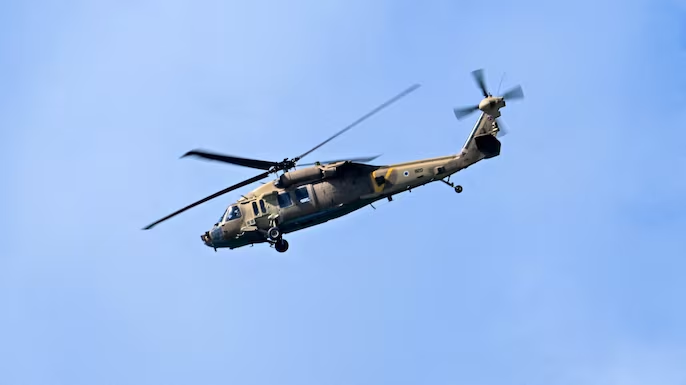
The story of the whole U.S. on Friday, April 3, 2026, air superiority was shattered when two American warplanes, Blackhawk—an F-15E Strike Eagle and an A-10 Thunderbolt II—were downed during combat operations over Iran. The A-10 pilot was able to eject and was rescued in Kuwaiti airspace.
However, the F-15E crew had a much worse fate in the mountains of Kohgiluyeh and Boyer-Ahmad Province. After a frantic 48-hour combat search-and-rescue (CSAR) operation, President Trump confirmed on Sunday, April 5, that the last missing crew member, a high-ranking weapons systems officer, was found in a miraculous night mission. As the April 6 deadline approaches, the situation is getting worse. This goes against what the White House said on Wednesday night, that Iran’s air defences had been 100 percent destroyed.
US Two Planes Down
In the theater of modern war, there is a specific, gut-wrenching frequency to the silence that follows a lost signal. On the afternoon of Friday, April 3, 2026, that silence echoed across the command centers of Operation Epic Fury. For thirty-two days, the American public had been told that the skies over Iran were a private playground for U.S. and Israeli stealth tech. Then, the “invincible” metal began to fall.
The first blow landed in the rugged, rain-slicked peaks of southwestern Iran. An F-15E Strike Eagle, the workhorse of the tactical air fleet, vanished from radar after being bracketed by what analysts suspect was a man-portable air-defence system (MANPADS). Minutes later, reports filtered in of an A-10 Thunderbolt II—the legendary Warthog—limping toward the Persian Gulf, its titanium skin shredded by ground fire.
The A-10 pilot, displaying the grit typical of the “A-10 cult”, managed to coax his dying machine into Kuwaiti airspace before punching out into the sea. He was home within the hour. But for the two-person crew of the F-15E, the nightmare was just beginning.
The Hunt in the Mountains
As we explored in the analysis of Tehran’s rainy-day defences, the Iranian regime has pivoted to decentralised, low-tech resistance. Iranian state media wasted no time, broadcasting images of twisted metal in the back of a truck and urging local nomadic tribes to “hunt the enemy pilots” for a bounty.
The pilot of the F-15E was recovered in the initial hours of the chaos, but the Weapons Systems Officer (WSO)—later identified as a U.S. Air Force colonel—was missing in the heart of hostile territory. This was the exact scenario the Wednesday address had promised would never happen. Trump had stood before the nation claiming Iran’s radar was 100 per cent annihilated, yet here was proof that “air superiority” does not mean zero risk.
The Midnight Miracle: The Rescue of the Colonel
The rescue operation that unfolded over the weekend of April 4-5 will likely be studied in military academies for decades. It was a race between U.S. HC-130J Combat King II planes and Iranian search parties. On the night of Sunday, April 5, under the cover of a moonless sky, U.S. Special Operations teams executed a “snatch-and-grab” mission so audacious that it required the Americans to scuttle their own damaged aircraft to prevent a technology leak.
President Trump, speaking from the White House just hours ago, confirmed the Colonel’s rescue. “He sustained injuries, but he will be just fine,” the President remarked, shifting his tone from the mocking bravado of his tech-firm comments to a somber recognition of the “miraculous” nature of the save.
The Fragile Shield of April 6
The downing of two planes in a single day is a jarring reality check for the 15-point peace plan currently sitting in Islamabad. While the U.S. has hit over 12,300 targets, the “Stone Age” warning has clearly not intimidated the IRGC’s frontline units.
The loss of these aircraft highlights a critical flaw in the “Epic Fury” doctrine: you can bomb a radar site, but you can’t easily find a soldier with a shoulder-fired missile hidden in a mountain crevice. As the April 6 deadline approaches tomorrow, the “Total War” is no longer a theoretical threat; it is a landscape of burning wreckage and high-stakes survival.
The U.S. has regained its pilots, but it has lost the illusion of an untouchable sky. As the world waits for the clock to strike 8:00 P.M. ET tomorrow, the question isn’t just whether Iran will sign the deal—it’s how many more “miracles” the U.S. Air Force has left in the tank.
Frequently Asked Questions (FAQs)
Q1: What exactly happened to the two U.S. planes?
On Friday, April 3, an F-15E Strike Eagle was hit by ground fire (likely a MANPADS) over southwestern Iran. Separately, an A-10 Thunderbolt II was damaged and subsequently crashed in the Persian Gulf region.
Q2: Were the pilots rescued?
Yes. As of Sunday, April 5, all three airmen involved are accounted for. The A-10 pilot and the F-15E pilot were rescued early on, while the F-15E Weapons Systems Officer (a Colonel) was recovered in a daring night-time mission on Sunday.
Q3: Does this mean the U.S. doesn’t have air superiority?
Military experts, including General David Deptula, argue that the U.S. maintains “a very high degree of air superiority,” but these losses prove that “air superiority does not mean zero risk,” especially against man-portable missiles.
Q4: How did Trump react to the planes being shot down?
Trump initially downplayed the incident, telling NBC News, “It’s war,” but later used the successful rescue to praise the military’s “miraculous” capabilities. He maintains that the April 6 deadline for the peace plan is still in effect.
Q5: What happened to the wreckage of the F-15E?
U.S. forces reportedly scuttled (destroyed) the remaining wreckage during the rescue mission to ensure that sensitive technology did not fall into Iranian or Russian hands.