Why Tehran is Warning Civilians to Flee the U.S. Shadow: The April 6 Countdown Begins

 |
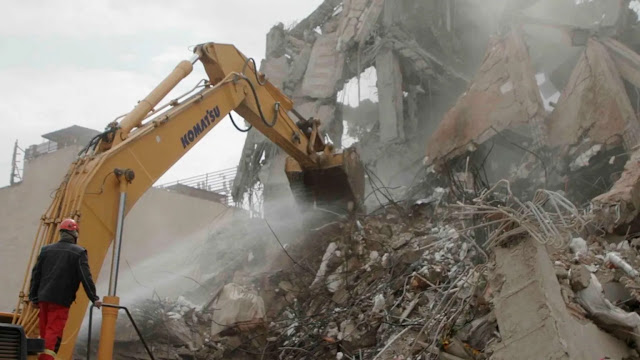
| Rescue workers dig through the rubble of a residential building in Resalat, Tehran, which was destroyed in an Israeli strike |
On March 27, 2026, Iran’s Islamic Revolutionary Guard Corps (IRGC) issued an urgent regional directive for civilians to stay away from areas housing U.S. military personnel. The Guards alleged that “American-Zionist forces” are using civilian infrastructure, including hotels and residential districts, as human shields to deter Iranian strikes.
This warning follows a month of high-intensity conflict and coincides with President Trump’s 10-day pause on energy infrastructure strikes. Analysts believe the evacuation order signals an impending Iranian escalatory phase—likely targeting U.S. logistics and personnel hubs in the Gulf—designed to bypass the current diplomatic stalemate and retaliate for the February 28 school strike in Minab.
Tehran’s Warning to the Streets
The silence of a ceasefire is often more terrifying than the thunder of a bombardment. On this Friday, March 27, 2026, a new kind of dread has settled over the cities of the Persian Gulf. While the stock markets reel and world leaders scramble to interpret President Trump’s ten-day breath, the Islamic Revolutionary Guard Corps (IRGC) has released a statement that feels less like a warning and more like a premonition of slaughter.
Stay away from the Americans, the directive reads. Across the region, from the high-rise hotels of Dubai to the fortified Green Zone of Baghdad, the message is clear: the U.S. uniform is no longer a shield; it is a bullseye.
The primary reason cited by the IRGC for this sudden evacuation order is a chilling accusation of human shielding. Tehran claims that U.S. forces, having seen 90% of their naval assets neutralized and their traditional bases hammered by ballistic missiles, have begun relocating into civilian-heavy zones.
According to the IRGC’s Sepah News, American-Zionist forces are attempting to use civilian locations and innocent people as human shields to prevent Iranian retaliation. By asking civilians to leave these areas, Iran is engaging in a sophisticated piece of international law maneuvering. Under the Geneva Conventions, if a belligerent party warns civilians to leave a target area, the burden of collateral damage shifts—at least in the court of public opinion—onto the party that remains embedded in the civilian population.
Tehran is effectively saying:
If we strike a hotel in Manama and civilians die, it is because they didn’t listen, and the U.S. shouldn’t have been there.
If we strike a hotel in Manama and civilians die, it is because they didn’t listen, and the U.S. shouldn’t have been there.
The specifics of the warning are what have sent ripples of panic through the regional expatriate communities. Iran has explicitly stated that hotels housing U.S. soldiers in the Gulf region are now legitimate targets.
This isn’t a theoretical threat. Throughout March 2026, we have seen the unrestricted nature of this war. From the tragic bombing of the Shajareh Tayyebeh Elementary School in Minab—where 175 children and teachers were killed—to the drone strikes on Kuwait International Airport, the traditional boundaries of the battlefield have dissolved. By urging civilians to leave, the IRGC is signaling that the next wave of strikes will not be confined to desert runways or remote silos. They are coming for the cities.
Propaganda or Preparation? The 10-Day Window
Is this 10 days for preparations? skeptics argue that this evacuation order is pure propaganda—a psychological operation designed to pressure Gulf host nations like Qatar, Bahrain, and the UAE into kicking U.S. forces out to protect their own citizens. If a hotel manager in Doha fears a missile in the lobby, they may stop accepting military contracts.
However, military analysts at the Institute for the Study of War (ISW) see something more tactical. The 10-day extension granted by President Trump ends on April 6. During this pause, the U.S. is moving the 82nd Airborne Division and 10,000 additional troops into position ready for next load. Therefore, now Iran knows that once that window closes, the Energy Plant destruction begins. By clearing the area now, Tehran is preparing for a first-strike scenario—a preemptive blow against U.S. troop concentrations before they can launch a ground invasion.
The timing of the evacuation order has coincided with a global stock market bloodletting. As civilians flee the areas around U.S. bases, the logistical backbone of the Middle East is snapping. We are seeing a mass exodus of foreign contractors—the very people who keep the oil flowing and the internet cables secure.
There is a growing fear that as Iran clears civilian populations, they are clearing the path for hybrid warfare. If the human shield excuse is established, Iran may feel emboldened to strike the undersea fiber-optic cables or desalination plants, arguing that these, too, are being used for American-Zionist military purposes. The digital darkness really shadowing us? that would follow a cable cut in the Red Sea would cost the global economy trillions, making the current $200-a-barrel oil look like a bargain.
The April 6 Countdown
As of today, March 27, the regional map is a grid of no-go zones. Civilians in Riyadh, Manama, and Abu Dhabi are watching the skies, caught between a U.S. military that promises protection and an Iranian regime that promises hell for anyone standing too close to the stars and stripes.
The IRGC has laid its cards on the table. They have warned the world. Now, the world waits to see if the April 6 deadline is a door to peace or the final warning before the storm.
FAQ
Q1: Why did the IRGC tell civilians to stay away from U.S. forces? The IRGC claims U.S. forces are using civilian locations, such as hotels and residential areas, as “human shields” to deter strikes. They issued the warning to shift responsibility for collateral damage and signal a shift toward targeting urban military hubs.
Q2: What specific areas are being evacuated? The warning is regional but specifically highlights areas near U.S. military bases, diplomatic posts in the “Green Zone” of Baghdad, and commercial hotels in Gulf cities that house American military personnel or contractors.
Q3: Is there a connection to the 10-day strike pause? Yes. President Trump paused energy infrastructure strikes until April 6. Analysts believe Iran is using this window to “clear the field” for a potential escalatory counter-attack or to pressure regional governments to distance themselves from the U.S. military.
Q4: What was the “Minab school strike” mentioned in the article? On February 28, 2026, a strike on the Shajareh Tayyebeh Elementary School in Minab killed over 175 people. Iran has used this tragedy as proof of “American war crimes,” fueling their narrative that they are now the ones trying to “protect” civilians via evacuation orders.
Q5: How should expatriates and foreign workers respond? The U.S. State Department and several European embassies have urged all citizens to leave the region immediately, citing “ongoing risks from rockets and drones” and the potential for a ground war following the expiration of the April 6 deadline.